
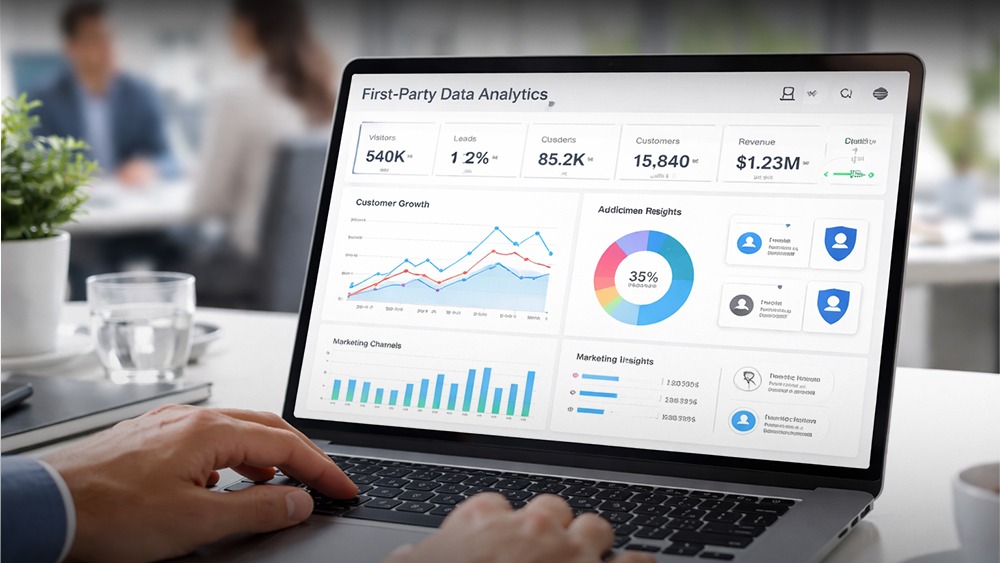
Welcome to the marketing revolution of 2026. You have probably experienced the digital advertising tectonic plates rolling under your feet, in case you are a business owner, a marketing executive or even a growth strategist in the USA. Days of the shaky third-party cookies, invasive tracking and the rented audiences are officially dead. Instead, a phoenix emerges, which does not only comply with the ever-shrinking web of privacy regulations, but is much more profitable, authentic and sustainable. It is first-party data marketing we are discussing.
By the time we hurtle into the year 2026, those brands that will be the most dominant brands in their niches will be those with the largest advertising budget, but the richest, most actionable and most consensual customer relationships. At Amanrasoft, we don’t just view this as a shift in technology; we view it as the greatest opportunity for American businesses to reclaim their marketing independence. We will discuss the reasons why First-Party Data Marketing is the new giant, how to develop a strong strategy, and how we are the architect of your future that is based on data.
Understanding First-Party Data Marketing and Its Importance for Your Business
We should define the fuel in order to use the power of the future. Marketers have long been obsessed with the spray and pray approach in decades past, where they purchased huge amounts of unverified untested lists of third-party data to fire at strangers. That method is not just inefficient anymore; it’s obsolete.
What Is First-Party Data in Marketing?
To put it simply, First-Party Data Marketing means the process of gathering and using the data that you have collected by your audience. This is data your customers willingly share with you through their interactions with your brand. It includes:
- Behavioral Data: Visits to the site, number of page views, interaction with products and time spent on the site.
- Transactional Data: Purchase history, subscription renewals and cart value.
- Demographic Data: Data that is given when creating an account or when completing surveys.
- Feedback Data: Customer service interactions, reviews, and survey responses.
Unlike second or third-party data, this is your data. It is the digital handshake between you and your consumer.
Why Is First-Party Data Better Than Third-Party Data?
First-party data is not only superior in terms of privacy, but also physics. Third-party information is using a warped carnival mirror, it provides a figure, but the details tend to be misleading. However, First-Party Data Marketing is a high-definition photograph.
You will remove the intermediary when you are using first-party data. You do not need to guess but know who exactly your customer is, what was desired the day before, and what most likely will be purchased the day after because he or she informed you. This data is:
- Accurate: No estimation models or probabilistic guessing.
- Exclusive: Your competitors are not able to purchase the same list of your customers.
- Actionable: Since it is based on intent with direct action, you can create offers with a scalpel precision.
First-Party Data vs Third-Party Data: Key Differences You Must Know
To fully enjoy the powerhouse position of the first party data, we shall pull a boundary line in the sand.
- Origin: First-party data is data that is acquired via your owned mediums (your app, your site, your CRM). Entities that are not directly related with the consumer aggregate third-party data.
- Compliance: First-party data is naturally in line with the privacy regulations, such as CCPA and GDPR, as it is based on direct consent. The issue of data used by third parties is frequently in the gray area of the law, particularly due to the 2026 privacy updates that are coming into effect.
- Reliability: Data supplied by third parties has a short shelf life; it depreciates quickly. First-party data is breathing, living, and keeps being updated as your customers interact with you.
- Cost: Although the acquisition of third-party data used to appear inexpensive, the returns are diminishing and the data used is ad waste. The returns on a first party infrastructure are compounded.
Preparing for 2026 Privacy Changes and Cookie Deprecation
The trend toward First-Party Data Marketing is not a movement but rather an inevitable process that is being pushed by laws and the policies of tech giants. When you run your business in the USA, it is similar to driving a ship without a compass and thus the changes are not to be overlooked.
How 2026 Privacy Regulations Will Impact Digital Marketing in the USA
2026 is shaping up to be the “Year of the Consumer” in terms of data rights. This is the domino effect with the states outside California enacting stringent privacy laws. These laws require that firms need to possess clear, detailed permission to process personal information. For marketers, this means:
- Passive tracking is over: You will no longer be able to track users around the internet without their explicit and voluntary permission.
- Higher cost of operation: Non compliance is not only bad PR but it is also accompanied by hefty fines.
- Emphasis on value exchange: This entails consumers providing data when they are guaranteed to get something in exchange.
Customer Data Privacy 2026: What Businesses Need to Know
On the other hand, the typical consumer of America in 2026 will be a digital native who realizes the worth of his data. They are cautious of brands which demand information without a definite why. Transparency is the new Customer Data Privacy 2026 standard. You should be in a position to provide any customer, at any point of time, with details of all the information that you have on them and give the option of deleting it immediately should they want.
CCPA Updates 2026 and GDPR for US Businesses: Compliance Essentials
Although the CCPA (California Consumer Privacy Act) and GDPR (General Data Protection Regulation) are not new, the changes, which are being implemented in 2026, are closing gaps. The new rules highlight to the US businesses:
- Sensitive Data: Tougher regulations relating to biometric, geolocation and health information.
- Automated Decision-Making: When you make decisions on consumers (such as loans or price adjustments) with the help of AI, you have to disclose it.
- Minimization of Data: You can not gather data in anticipation. You need to gather only that which is needed in the given purpose.
Will Third-Party Cookies End in 2026? How Businesses Can Adapt
That is the question that is on the mind of every marketer: Is There a Third-Party Cookies End in 2026? Although the deprecation timeline of Google has been a moving target, the fact is that the usefulness of third-party cookies has already been killed. They have been blocked by the major browsers such as Safari and Firefox over the years. The internet will completely become a cookie free environment by 2026. The answer isn’t to find a workaround; it’s to embrace Marketing Without Third-Party Cookies.
How to Replace Third-Party Cookies With First-Party Data
Substituting cookies is not a quest of seeking a different tracking pixel; it is the shift towards the philosophy. You need to concentrate on transforming anonymous traffic to known individuals rather than pursuing the anonymous users. This involves:
- Identity Resolution: Relating behavior of a user on one device to the same profile on another (with permission).
- Zero-Party Data: Proactively requesting users to share preferences through quizzes, preference centers and interactive content.
- Contextual Targeting: Don’t target the individual with a cookie, target the context of the content that the user is reading.
To help you navigate this complex transition, Amanrasoft offers specialized First-Party Data Strategy Consulting. Our professionals assist you in laying out a vision that will turn your enterprise into a data powerhouse that does not need cookies.
Building a Robust First-Party Data Strategy for Your Business
Developing a strategy may seem like an uphill challenge, yet it would reduce to three main pillars consisting of Collection, Unification and Activation. Lacking a plan, data is noise. It is a superpower with a strategy.
How to Build a First-Party Data Strategy That Drives Marketing Growth
You need a blueprint. A successful strategy starts with identifying your “North Star” metric. Is it customer lifetime value? Is it email capture rate? After establishing your purpose, you have to do a tech stack audit. Is your infrastructure in place to gather, store and divide this data? This is where our expertise becomes invaluable.
If you are looking for a structured approach, we highly recommend reading our dedicated guide on How To Build A First-Party Data Strategy . It breaks down the technical and operational steps required to lay a solid foundation.
First-Party Data Collection – Ecommerce Brands and Small Businesses
Ecommerce brands are sitting on a goldmine of behavioral and transactional data. For small businesses, the agility to pivot to first-party data is actually an advantage over larger, lumbering corporations. First-Party Data Collection For Ecommerce Brands involves capturing data at every touchpoint: from the first site visit to post-purchase follow-ups. For small businesses, localizing this data—understanding the neighborhood buying habits—can create a “David vs. Goliath” advantage. Similarly, First-Party Data Solutions For Small Businesses are designed to be lightweight, affordable, and scalable, ensuring you don’t need a massive IT department to get started.
Best Methods to Collect Customer Data Ethically and Legally in the USA
Ethical collection is the cornerstone of success. The best methods include:
- Progressive Profiling: You can request one piece of information (such as email) on day one and then add information to the profile progressively.
- Preference Centers: Giving the user the opportunity to share with you what they would like to hear.
- Loyalty Programs: An old, yet very efficient method of associating the purchase behavior with a particular identity.
- Interactive Content: High-engagement tools are high-quality in terms of interactions and provide high-quality data (quizzes, calculators, and assessments).
Customer Data Collection Best Practices for Privacy-First Marketing
Transparency is important when we discuss customer data collection best practices. You should not use dark patterns (deceive users). Rather, plain simple words on how you will use the data. Keep in mind that in 2026, trust is the new currency.
How to Personalize Customer Experience With First-Party Data
The ultimate goal of all this data is personalization. The first-party data allows you to go beyond using Hi, [First Name] in an email. You are able to make the web experience of the web dynamic in that the home page hero image would switch depending on the past purchase or the past browsing history of the visitor. You can send abandoned cart emails that are specific to the color and size left behind. This level of detail is only possible through a well-oiled first-party data machine.
First-Party Data Marketing Benefits and Solutions for Businesses
Why go through all this effort? Because the benefits are astronomical. First-Party data marketing isn’t just a compliance necessity; it’s a profitability engine.
Marketing Growth। First-Party Data in the USA
We are seeing that US businesses utilizing first-party data are outpacing their competitors by 2-3x in revenue growth. The reason behind this is that it is possible to spend hyper-efficiently with Marketing Growth Using First-Party Data. You will stop spending money on audiences that are not aware of your existence, and begin spending money on audiences that already love you.
Benefits of First-Party Data in Advertising Campaigns
Feeding first-party data into a platform like Google Ads or Meta Ads results in the formation of so-called custom audiences, which are lookalike models. The algorithms are more effective as they have high quality signals to study. This results in:
- Lower Cost Per Acquisition (CPA)
- Higher Click-Through Rates (CTR)
- Improved Return on Ad Spend (ROAS)
How Businesses Can Use First-Party Data to Boost ROI
The ROI improvement occurs due to an easy formula, Better Data = Better Targeting = Higher Conversion Rates. With the lifetime value of your customer, you will know just how much you will be able to spend to acquire them, creating growth that is scalable and predictable.
To see the extent of this application, read How Businesses Can Use First-Party Data to make their marketing departments profit centers instead of cost centers. Also, you can predict the future behaviours, not only analyze the past and leverage AI-Powered Customer Insights.
First-Party Data Solutions USA: Affordable Tools and Platforms
This is because there are many tools in the market but the challenge is to find the best tool that suits the US market. Companies require solutions that do not violate the privacy regulations in the US but can be easily incorporated into the American tech stack (Shopify, Salesforce, HubSpot). The Amanrasoft First-Party Data Solutions USA are concerned with affordability and scalability. With either a startup or an enterprise, we assist you to choose and use the tools that fit your budget.
Best First-Party Data Tools for Marketing in 2026
The most effective tools will be Customer Data Platforms (CDP) integrated with AI analytics in 2026. Find platforms that provide:
- Real-time data streaming
- Unified customer profiles
- Predictive scoring
- Native integration with ad networks
In case you are a small or a mid-sized business, and worry about budget-related issues, look into fair-priced customer data platforms. The platforms provide enterprise-grade functionality at the price point of an enterprise, making the best data strategies accessible to anyone.
AI-Powered Customer Insights and Data Analytics Services
Data without analysis is just noise. It is here that AI comes in. The current AI-Powered solutions are capable of sorting through millions of data points to define micro-segments, forecast churn risk, and even recommend the next best action to a salesperson. Combining this and powerful Customer Data Analytics Services will make sure that you are not merely gathering data but utilizing it to make decisions.
Privacy-Compliant Marketing Strategies and Tools
Working through the legal environment is equally significant as working through the technical environment. A lapse in one compliance will lead to fines that can put a small business out of business.
Privacy-First Marketing Strategies for 2026
The user is in control in a privacy-first approach. It consists in planning marketing campaigns in which the default option would be no tracking until the user clicks on it. It consists of making sure that your marketing automation software is set up to honor Do Not Track signals. This approach not only keeps you safe legally but builds immense brand loyalty.
How to Collect Customer Data Legally and With Consent
The keyword is “consent.” Consent must be:
- Freely given: Not bundled with terms of service.
- Specific: Not a blanket check box.
- Informed: Clearly explained.
- Unambiguous: An affirmative action (no pre-ticked boxes).
User Consent Tracking Tools and Marketing Automation
To manage this at scale, you need robust tools. Marketing Automation And User Consent Tools allow you to sync consent preferences across your entire tech stack. If a user withdraws consent in your email platform, it should automatically update your CRM and your ad platforms. This synchronization is critical for maintaining data integrity.
Prepare for 2026 Privacy Updates: Steps to Stay Compliant
To prepare for the upcoming privacy updates, you should:
- Conduct a data audit to see what you are collecting and why.
- Update your privacy policy to be more transparent.
- Implement a Consent Management Platform (CMP).
- Train your marketing team on the nuances of the new CCPA and state-level laws.
Data Compliance Requirements USA 2026: Everything Marketers Must Know
Marketers in 2026 must know that data compliance is no longer just the job of the legal department. It is a marketing KPI. The Data Compliance Requirements USA 2026 are expected to mandate “universal opt-out mechanisms,” making it easier for consumers to tell the entire internet they don’t want to be tracked. Marketers must be ready to honor these requests instantly.
Why Choose Amanrasoft for First-Party Data Marketing in the USA
Navigating the intersection of technology, strategy, and legal compliance requires a partner who understands all three. Amanrasoft is that partner.
Expert Guidance on First-Party Data Strategy and Implementation
You don’t have to figure this out alone. Our team specializes in turning complex data challenges into streamlined marketing advantages. We offer comprehensive First-Party Data Marketing Services designed to take you from zero to sixty in your data journey. We don’t just advise; we implement.
Low Cost Customer Data Platforms and Solutions for Businesses
We understand that every business has a unique budget. That’s why we champion Affordable Customer Data Platforms that deliver maximum ROI. Whether you need first-party data solutions for a complex enterprise-grade architecture or small businesses, we have a solution.
Hire Data Privacy Consultant Services USA for Compliance & Growth
Staying compliant while growing is a balancing act. You can Hire Data Privacy Consultant Services Usa through us to ensure that your marketing strategies are bulletproof against legal challenges. Our consultants stay up-to-date on the latest CCPA Updates 2026 and GDPR for US Businesses, allowing you to focus on growth without fear.
Top Marketing Agencies for First-Party Data Strategy: Amanrasoft Advantage
What sets us apart as one of the Top Marketing Agencies for First-Party Data Strategy? It’s our holistic approach. We combine First-Party Data with hands-on execution. We help you design Personalized Marketing Strategies that resonate deeply with your audience, leveraging user consent tools & marketing automation to execute at scale. Our expertise ensures that you master Marketing Without Third-Party Cookies while building a sustainable asset—your customer data.
How We Helps Businesses Thrive After Cookie Deprecation
The post-cookie world is not a wasteland; it is a garden waiting to be cultivated. At Amanrasoft, we provide Privacy-Compliant Marketing Solutions that ensure you don’t just survive the deprecation, but thrive because of it. We help you shift your mindset from renting an audience to owning a community.
The End Note!
The future of marketing is all about the data you own. By moving away from old, unreliable trackers and embracing your own customer info, you are setting yourself up for massive success. 2026 is going to be a big year, and those who start their First-Party Data Marketing journey today will be the ones leading the pack tomorrow. Remember, your customers are your greatest asset. Treat their data with respect, use it wisely, and watch your business reach new heights!